Valley Children’s Clinic to receive lead screening machine
Published 1:30 pm Thursday, April 30, 2026
Despite areas of high risk of lead exposure, Washington state has one of the lowest blood lead testing in the country, and Seattle Children’s Care Network (SCCN) is partnering with Molina Healthcare of Washington to make testing more accessible across the state, including Valley Children’s Clinic in Renton.
Childhood exposure to lead can have “adverse long-term effects on physical health and brain development,” even at low levels. Molina has awarded SCCN with a $40,000 grant that will fund lead screening machines for at least six locations: North Seattle Pediatrics, Pediatric Associates of Whidbey Island, Richmond Pediatrics, South Sound Pediatrics in Olympia, Woodinville Pediatric Clinic and Valley Children’s Clinic.
The grant will also support educational awareness to “increase the number of children screened annually and improve connections to treatment when needed.” The machines will be delivered to the clinics at a date that is yet to be determined.
“Given the lifelong impacts of lead exposure, it is critical that we increase access to testing for newborns and children. By funding screening machines for clinics that currently do not have them, Molina is helping to ensure underserved areas can increase their screening rates, leading to early detection and treatment so children in Washington are given a healthy start,” said Dr. Kenisha Campbell, chief medical officer at SCCN.
According to the Washington Department of Health (DOH), lead is a naturally occurring metal in the environment that can be found in soil, water, the air and inside many homes. Children under age 6 are the most affected by lead exposure, as their growing bodies are more sensitive to the damaging effects. Lead exposure can cause lower IQ, behavior problems, learning problems, hearing problems, slowed growth and anemia in children.
The DOH says that babies and children can be exposed to lead by:
• Breathing or swallowing lead dust from lead-based paint or lead-contaminated soil.
• Putting their hands and other objects, which may have lead dust, into their mouths.
• Eating and drinking food or water that has lead.
• Using cookware, dishes, or glasses that have lead.
• Playing with toys that have lead paint.
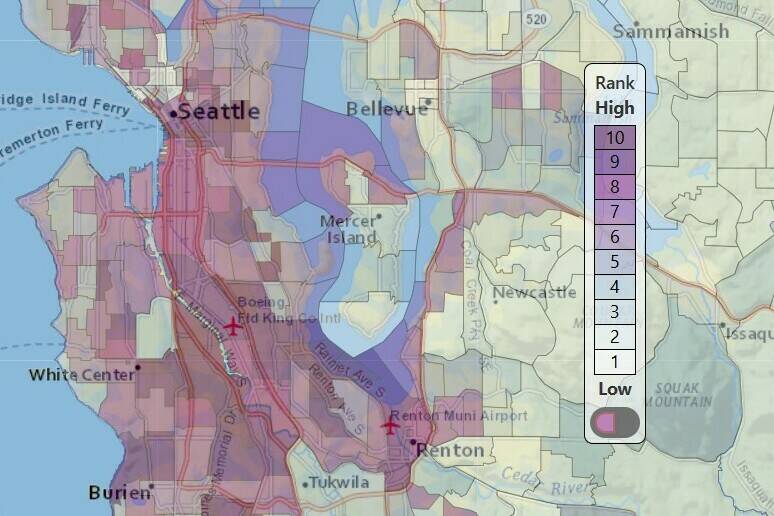
The DOH website has a lead exposure map that shows what areas of Washington state have the highest exposure risk on a scale of 1-10, with 10 being the highest. Currently, the map shows that in Renton, the areas that have a ranking of 9 include water and soil near the Renton Airport, the Boeing Factory, The Landing and Downtown Renton.
“Investments in testing for environmental toxins, like lead exposure, is part of Molina’s commitment to creating a healthier future for Washingtonians,” said Dr. Jay Fathi, plan president for Molina. “Our partnership with the Seattle Children’s Care Network will bring life-saving technology to our local communities so children can be tested early, minimizing the impact that lead exposure has on their overall health and development.”
To learn more about lead exposure and to access the lead exposure risk map, visit doh.wa.gov/community-and-environment/contaminants/lead.