The summer danger, allure of Cedar River
Published 10:58 am Friday, May 18, 2012
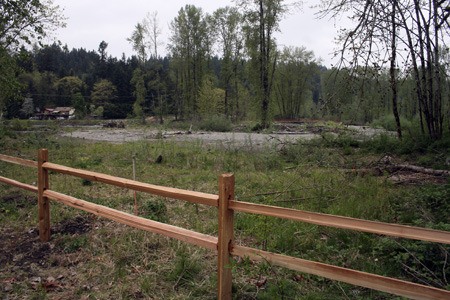
King County has placed a wooden fence along the Cedar River near the Riverbend Mobile Home Park in hopes it will discourage children and others from venturing too close to an ever-changing river bank.
This time of year, the Cedar River is running fast and cold, as the Cascade snowpack melts quickly in the spring heat. For those who venture too close or are inexperienced in rafting it safely, the Cedar is dangerous.
Last weekend the summer-like temperatures sent thousands of people to the region’s lakes and rivers.
“The large number of people enjoying area lakes and rivers kept the Sheriff’s Office Marine Unit very busy,” said Sgt. Rodney Chinnick, a Sheriff’s Office spokesman.
The Marine Unit responded to incidents on Lake Washington, Lake Sammamish and the Green River, including the death of an Everett City Council member who died while rafting near Black Diamond.
The Sheriff’s Office again stressed the importance of wearing life jackets while rafting rivers or boating in lakes or simply playing near the shore. Public Health – Seattle and King County also promotes their use.
However, unlike last year, there is no proposal to impose a requirement that everyone rafting the river in any device must wear a personal floatation device, such as a life jacket, according to Logan Harris, a spokesman for the King County Department of Natural Resources.
Last year’s emergency rule applied to anyone swimming, floating or boating on a river, including the Cedar, Snoqualmie, Tolt, Green, White, Raging and Skykomish rivers that run outside cities.
“While we did see heavy snowpack, one difference this year is we didn’t have the turbulent flood season we did in 2010-11 when virtually all rivers experienced extended high flows that compounded already high risks for boaters, rafters and swimmers,” Harris said.
However, he added, “rivers are dynamic systems that are inherently dangerous, particularly this time of year.”
A massive logjam closed the Cedar River last year for several weeks upriver from the Riverbend Mobile Home Park, the result of that winter’s high river flows. It was later removed and the river reopened.
The mobile-home park is just east of the Renton city limits on State Route 169.
This year, there were no significant river flows, so there are no new logs spanning the river in that area nor has the river’s channel changed, said Steve Bleifuhs, manager of the county’s River and Floodplain Management Section.
“What folks will see this summer is what they saw last summer,” he said.
The King County Flood Control District is updating its flood hazard management plan designed to keep residents, businesses and economic infrastructure safe from flooding.
The stretch of the Cedar near the mobile-home park is known as Cedar Rapids. Farther upriver is a major logjam that blocks a side channel that continues to draw the concern of river activists. It has been in place for years.
Chuck Pillon of May Valley has spent years pressing the county to make rivers such as the Cedar safer places for recreationists, including in the Cedar Rapids stretch of the river. Using his own money, he put up a temporary chain-link fence around the mobile-home park.
His concern has been the risk that large logs and other woody debris, some of it placed by the county as fish habitat, pose to people using the river for sport.
Crews with King County recently installed about 800 feet of wooden fence between the river and an open area and then the mobile-home park. Pillon’s chain-link fence remained in place, too.
He called the county’s fence “a joke.”
“It will not keep kids out,” he said.
The split-rail fence near the mobile-home park is commonly used in parks, said Bleifuhs. It’s designed to limit public access to areas where the river’s banks are eroding, he said.
“We want to make sure people know that as they access the site to use caution,” he said. The project will include some interpretive information, too.
The fence on the river’s west side wasn’t part of the original fencing plan designed to address the the east side of the Cedar where the bank continues to erode. But the county reconsidered after listening the Pillon’s concerns, Bleifuhs said.
But Pillon is not done.
Next on his list is the logjam in the side channel across State Route 169 from what was once a county maintenance facility and is now a recycling business.
“The log jam is now the target,” he said of the site upriver from Cedar Rapids. “I am going to take a chain saw to it.”
Years ago, Pillon did something similar, pulling logs from the Cedar and running afoul of the law.
The county has assessed the side-channel logjam a number of occasions, including with the Sheriff’s Office, Bleifuhs said, concluding that it will leave the natural logjam in place. It’s visible to rafters and boaters headed down river and there are warning signs. The monitoring will continue.
The logjam hasn’t changed and is “well anchored,” he said. The main flow of the river – about 99 percent – goes to the right of the side channel, he said. Some water does fill the channel in high water, he said.
Next, sometime this summer the county will install a fence on the east side of the river roughly directly across from the Riverbend park. That’s the site where crews removed a large logjam last spring that had forced the closure of the Cedar River to rafters.
First, the county will remove a “pinch point” where a levee pushes out into the river, causing it to narrow and speed up.
The county had placed large rocks in the winter of 2010 in an emergency project to prevent damage to nearby homes from high river flows. The county received a violation from U.S. Army Corps of Engineers for placing those rocks without a permit.
Now, by removing the rocks, the county will take care of the violation.
In order to remove the pinch point, the county purchased a house and land for $280,000 that the emergency levee project was designed to protect. The work will be done in July or August.