FIREFIGHTER FOR A DAY | Part II: A job best left to professionals
Published 12:09 pm Thursday, May 16, 2013
To read Part I of “Firefighter for a Day,” click here.
‘Labor intensive’
After a quick rest and check of my vital signs, we headed into the “megacode” prop, designed to give us an idea of the amount of manpower needed during a CPR event.
New standards require firefighters to give constant chest compressions and studies have shown that effectiveness drops precipitously after two minutes, meaning someone has to be on hand to tag in and take over. At 100 compressions per minute, the arms tire fast and two minutes is not enough recovery time to be effective after a few shifts.
We continued CPR as we loaded the dummy on to a back board, strapped it down and then carried it down the stairs to a waiting ambulance. We climbed in with the backboard and then got a chance to see how difficult it was to continue CPR in the back of a bouncing ambulance on its simulated way to the hospital.
Throughout the CPR prop, the firefighters pushed the need for more personnel and explained that the exhaustion is why so many firefighters and emergency personnel are needed on the site of a seemingly simple event.
Car fire
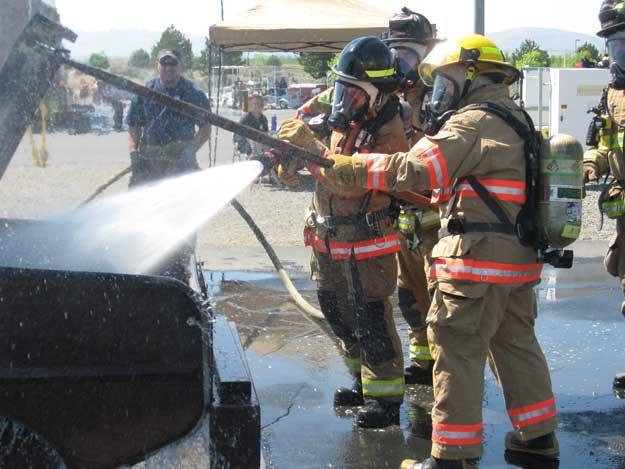
After another quick break, my team, one of six spread across the facility, headed over to the car fire prop. It was our first chance to handle a hose and get up close and personal with fire.
We took turns using the hose or the hook to open the trunk, doors and hood to allow the fire to be sprayed.
Again we were reminded that in the real world, the car is rarely sitting on a gravel pad by itself and the latches on the trunk and hood are never as easy to bypass as the non-latched version we battled. Also, in real life, the fire is uncontrolled and tires and nearly everything else in a modern car can explode.
But even with those real-world concerns aside, simply maneuvering the hose and pole while staying far enough away to not get burned – all while breathing through the mask – is not easy and takes teamwork.
The ‘commute’
 From the car fire, we headed over to the ladder truck.
Stretching 105 feet up, the ladder presents its own unique challenges. As I stood at the bottom and waited my turn, I was not worried. As a kid, I was a climber. I climbed anything and everything: tress, ladders, buildings, water towers, it didn’t matter.
But wearing the gear and full pack, the climb is a lot more difficult. And bouncy.
By the time I reached the top, I was pretty tired. And again, “the work starts when we get to the roof,” we were told before starting up.
After having an opportunity to catch our breath, something firefighters can’t take time to do during an actual fire, I took the stairs back down and headed over to the roof simulator, where I was handed a rather heavy chainsaw and reminded that I would have had to bring this and other tools with me up the ladder while I climbed, before they let me cut through the simulated roof.
But even safely on the ground the chainsaw, used to cut a hole in the roof to vent heat, smoke and gas and allow firefighters on the ground to enter and begin battling the actual blaze, is still heavy and difficult to use, especially to the unpracticed.
The burn house
 By the time we reached the burn house, fighting a fire felt like a reward. They lined us up with our shadow and team-by-team we crawled in and were confronted with thick smoke and fire spreading across the ceiling.
Something funny happens in the brain as you are about to enter a room filled with fire: it boggles at the choice you’ve made and begs you to reconsider your sanity as it works to outmuscle your legs.
Nevermind that it’s a controlled, propane fire in a specially designed burn house or that you have a fully charged firehose and a professional firefighter with you.
None of that matters as the door opens and a rush of thick smoke envelops your breathing mask or as you catch a glimpse of the hot orange tendrils racing across the ceiling above you, hinting at a blaze you can almost see behind the smoke.
The mind recoils and the legs follow. It takes a conscious effort to put your personal safety at risk and charge into a burning room, even during a training burn.
On the floor, you glance up through the mask, listening to the Darth Vader-like sound of your own breathing getting heavier with every inch and feeling your pulse quicken. The flames are starting to spread through the house and despite the 40 pounds of protective gear, you can feel the heat on your face.
As you ease back the bale nozzle the hose kicks to life, pressing you down further as you aim it at the flames.
With the fire finally out, I closed the bale again and relaxed a bit until Jesse, my shadow, tapped me on the shoulder.
“Ok, good work. Now move on to the other room,” he said.
The Jaws of Life
By this time, I was feeling the effects of the day. Our group of five had already lost one member to the heat and after the check of vitals following the burn house – which included a demonstration of just how difficult it is to use one of the high-pressure hoses on your own – we’d lose a few more.
 But the job wasn’t done yet, so I soldiered on to the final prop of the day: The Puyallup Extrication Team’s demonstration on getting victims out of a car wreck.
Sitting on a hot tarmac in full gear, we got all of our instructions and a safety lesson. Then, the instructors, who go around the country and world demonstrating and teaching their techniques, helped as we proceeded to use a jack to further open the back window of the car to get to the victim and use the saw-all and Jaws of Life to cut the roof off of a car.
The tools make the job easier, but they are heavy and bulky and after a tiring day in the 100-degree sun, not easy to use. Sometimes, the gear actually got in the way and affected my balance.
In my Converses and shorts, jumping on the hood of a car and balancing while I cut through a windshield would not be a problem, but the additional weight and the awkward size of the pants and boots made balance more difficult than I’d like to admit.
Graduation
After we finished, we walked back to the air-conditioned meeting room. My heart rate was way out of whack and I was exhausted. I could barely eat and continued to sweat throughout the entire 45 minute “graduation” ceremony.
But I wasn’t the only one. Elected official after elected official struggled to pick up their helmet and certificate and nearly to a person promised to remember just how difficult their day was at budget time, especially the importance of manpower when it comes to saving a life.
 Later, after safely back on this side of the mountains, I asked Renton firefighter and union public relations director Ryan Simonds how the day compared to the real thing.
Simonds said FireOps provides a good look at what firefighters do, but pointed out that every situation was a perfect training simulation, without families, furniture or other distractions and dangers.
On top of that, the smoke I faced was not like the real thing, which is blacker and hotter.
“We’re not allowed to throw a couch in there and show you what these synthetic materials can do,” Simonds said, adding that while not every day has so much in it, most calls combine several of the props into a single event.
On top of that there’s the knowledge that someone — not just a dummy — may be inside and need help.
Let there be no doubt: Firefighting is difficult work. It is, in fact, “labor intensive,” “highly technical” and “time sensitive.”
At the day’s end I was hot, exhausted, hungry and my knees were bruised from crawling around all day.
But I’d received my helmet and certificate and was very proud of completing the day, especially in the intense Eastern Washington heat.
And I can honestly say I have a new respect for the men and women of our local fire departments and I no longer have that schoolboy desire to be a fireman.
That’s work for professionals. Never doubt it.