Lindbergh grad offered Kurdistan post
Published 11:30 pm Monday, December 22, 2008
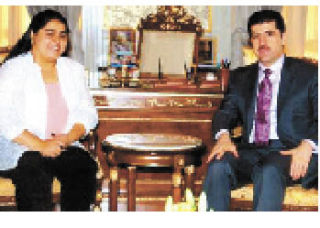
Dalia Amin wasn’t born in Kurdistan and has never lived there. But she has always wanted to make a difference in the middle-eastern region she calls home.
A recent offer from the region’s prime minister would allow the 18-year-old to fulfill that goal.
Prime Minister Nechirvan Barzani offered the 2008 Lindbergh High School graduate a job with the Kurdistan government in four years, after she graduates from the University of Washington.
Barzani offered Amin a position after a meeting this summer. He learned about Amin and her Kurdish community service from her appearance on a couple television and radio interviews. Amin’s uncle, who owns a Kurdish television station, first spotlighted his niece.
Amin then won two national awards in Kurdistan — one from the region’s president and the other from the governor. These awards were for Amin’s community involvement and her academic success. At Lindbergh, Amin was an AP and honors student with a high GPA and a long list of extracurricular activities. She belongs to several clubs at UW, including ASB.
Following her media attention, Barzani arranged some face time with Amin. During their meeting she told him she had three major choices: whether to study medicine, politics or business.
Barzani convinced her to choose political science, to prepare for a role in his government. He also gave her $10,000 for her studies. Amin already has a grant and scholarships, so she invested the money into an uncle’s construction business.
Amin is a proficient investor. The stock market portfolio she and a Lindbergh partner developed won first place two years in a row at an international conference.
Amin says she’s “building herself as a political female,” and has always hoped to become one of Kurdistan’s leading women. A woman who will help guide the region into a successful future.
Kurdistan is an autonomous region that occupies northern Iraq, northwestern Iran, northeastern Syria and southeastern Turkey. The Kurds are a minority in each of these
countries, and have been repressed throughout history. Numbering 40 to 45 million, the Kurds are the largest ethnic group without a country.
Amin’s parents are both from Kurdistan — the north Iraq part. As refugees, they spent 11 years in Pakistan awaiting relocation to the United States. Finally, in 1999, the Amin family moved to the United States. Amin, who was born in Pakistan, has citizenship in Pakistan, Iraq and the United States.
Here in the United States, Amin’s works with two groups: Kurdish Community and Family Care. The latter is a nonprofit she runs that helps Washington newcomers with translations, job searches and citizenship applications.
Amin also wrote about the local Kurdish community for The Kurdish Globe, Kurdistan’s first English newspaper.
In four years, Amin will likely be able to add “Kurdish politician” to her resume. She says she could take a position in Kurdistan as a “politician, financial minister or maybe an international affairs minister.”
Ultimately she wants to work in the United Nations or as a U.S. ambassador.
“I’ve always had it in mind to work in America and my home country,” Amin says. “Now I have the opportunity and the reason to work there. It’s exciting.”