Renton program targets backlog of missing sidewalks
Published 10:30 am Wednesday, May 6, 2026
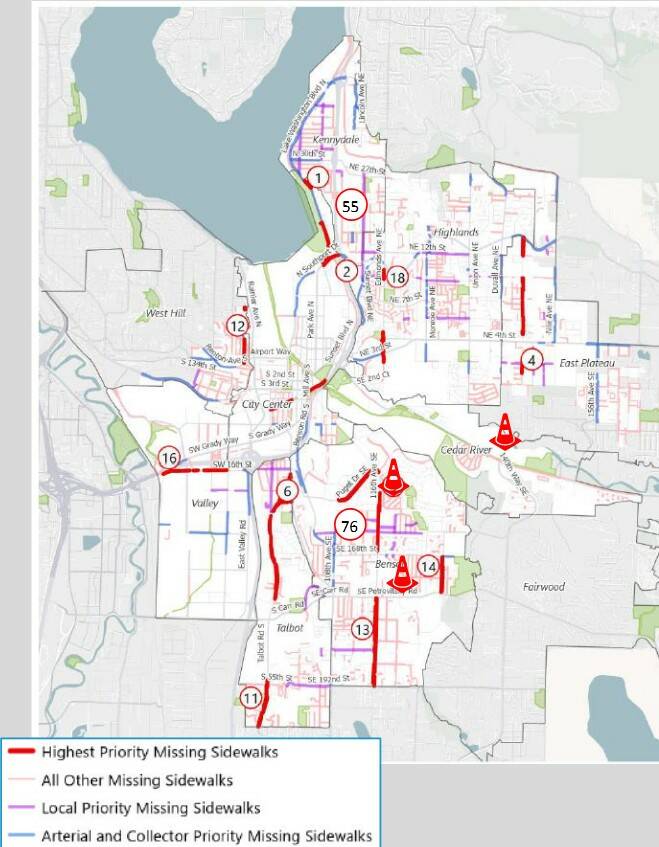
The city of Renton is taking steps to address the city’s missing sidewalk network to prioritize safety and community connectivity.
At the April 26 Renton Committee of the Whole meeting, Transportation Planning Manager Ellen Talbo presented the latest updates to Renton’s Comprehensive Walkway Program, the city’s plan to tackle a backlog of missing sidewalks, particularly in older neighborhoods and areas annexed from King County.
“We used a data-driven process to prioritize how to get at infilling as much of the missing sidewalk network as much as possible because there is quite a bit,” Talbo said.
The city identified 81 priority segments and tiered their importance by connectivity and proximity to schools, transit and other walking destinations such as shopping hubs and parks. Segments that have experienced a high crash rate also received more prioritization. The city identified 18 segments as the highest priority.
The current projects under construction are the Maplewood Sidewalk Project, the SE 116th Avenue Sidewalk Project and the SE 172nd Street Water Quality Retrofit Program. Other projects targeting those 18 segments in the coming years include:
• Talbot Road from S. 192nd to S. 200th streets.
• Aberdeen Avenue NE from NE 28th Street to NE 12th Street and NE 24th Street.
• SE 164th from Jones Avenue to 125th Avenue SE.
• Hoquiam Avenue from Sunset Avenue to Hazen High School, and NE 10th Place to NE 8th Place.
However, translating planning maps into physical infrastructure comes with significant engineering hurdles. Talbo said that steep slopes, stream crossings and narrow residential streets make adding sidewalks more difficult.
One of the largest financial barriers for sidewalks is above-ground utility poles, which are supposed to be moved underground when new sidewalks are installed. However, Public Works Director Martin Pastucha said that because of the costs, the poles are usually relocated.
“It takes a lot of time, it has a lot of impacts,” Pastucha said. “I’m trying to get staff to talk about walkways versus sidewalks because we want to spread the TBD dollars as far as possible because when you look at 18 projects, it could be very expensive.”
Instead of sidewalks, sometimes the city can build asphalt “walkways” with protection from the street to avoid relocated utility poles.
“What’s important for people is that they feel safe where they’re walking,” Pastucha said.
The city will now move forward with preliminary engineering on the priority segments and evaluate utility conflicts and environmental factors to determine the best fit for each new walkway.