Prosecutor’s Office offers workshop to bring truant kids back to school
Published 11:00 am Saturday, February 11, 2012
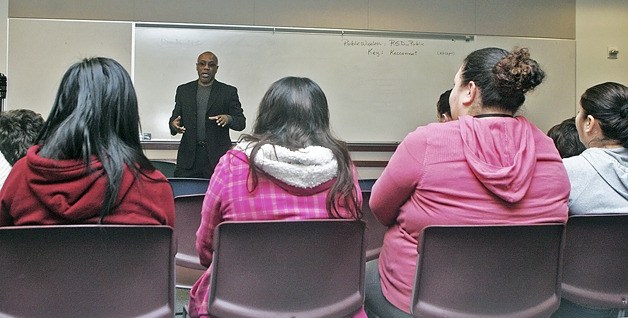
There was a time when Terrell Dorsey was too cool for school.
He had personal issues coming up in school that he says changed the adult quality of his life. Those issues led to his incarceration.
“The point is that if you don’t protect your high school years, once you become an adult you’re not going to land any place safe,” Dorsey said.
Now he is the founder of the group Unleash the Brilliance, which does presentations at truancy workshops offered by the King County Prosecutor’s Office.
Dorsey and three youth, who have overcome or are working on their issues around truancy, were in Renton recently for a regional workshop.
Truancy workshops are really programs of drop-out prevention, said Dan Satterberg, King County prosecuting attorney, in an interview.
“We know that in the state prison system that three out of four inmates in our prison system were high-school dropouts,” he said. “Seventy-five percent, that’s a really telling statistic that for one reason or another they could not finish school and ended up in prison.”
The truancy-prevention program started by the King County Prosecutor’s Office is now in its third academic year.
The office reports that during the 2010-2011 school year, 1,405 petitions were filed countywide by school representatives to begin truancy proceedings. Of those, only 258 proceeded to the initial hearing. The remainder of 1,147 were dismissed because the students were re-engaged in school and working with school representatives.
So for a prosecutor to be involved in a dropout prevention program is significant, said Satterberg.
“I think it is squarely within my responsibilities, because keeping kids in school is our best crime prevention,” Satterberg said.
In Renton, 70 kids have been petitioned by the school district for the truancy process so far this year,” said Marsha Linn, who is the Renton School District representative attendance liaison.
That number is low, she says, because they are doing such a wonderful job with interventions early on.
The dropout rate in the district for 2009-2010 was 4.7 percent or about 190 students.
Linn spends 30 hours a week in the schools talking with students, families, vice principals, counselors and attendance specialists to discover why a child is not attending school and how to intervene.
So why are kids truant these days?
“If you’d asked me five years ago, I might have given you a whole different answer,” Linn said. “But, right now I see a lot of kids who are really really suffering with the economy.”
Kids are staying home to babysit younger siblings or some feel that they have to work to support their families, she said.
“So, they’re kind of the silent victims of the economy right now,” Linn said.
Reasons also run the gamut from social anxiety, illness and to drugs and alcohol. Or, sometimes a child gets so far behind in school that he or she feels like there’s no reason for them to go anymore.
“Actually, there’s very few kids who I work with who say I don’t like school, school’s not a good place for me, I don’t want to go,” Linn said. “They usually have a reason, maybe not good enough as far as the law is concerned. But, they have reasons why they’re not attending.”
The law states that if a child misses seven unexcused absences in one month or 10 unexcused absences during an academic year, they are considered truant.
In the Renton School District, representatives try to catch up with students at five unexcused absences to find out what’s going on.
In Washington state the truancy law is known as the Becca Bill. It requires the school, school district and the juvenile court to take specific actions when youth are truant.
When a student gets up to the maximum unexcused absences, the school district may file truancy petitions with the juvenile court.
If the student doesn’t comply with the court order resulting from the petition, meaning they haven’t returned to school and aren’t doing the things specified in their agreement with the school, then the school is required to file a contempt motion.
During the juvenile court requirements, the court may order attendance at the current school, an alternative school, another public school, a skill center, a drop-out prevention program, such as the prosecutor’s office workshops.
Or, they may ask that the child attend a private school, an education center or refer them to a Community Truancy Board or ask them to complete a drug assessment test.
The juvenile court may order the student to report to county detention, impose alternatives to detention, or order parents to perform community service or pay a fine of up to $25 per day for each unexcused absence, if they deem that student or parent violated the court order.
Fourteen-year-old Marcus was headed down that path in the Kent School District.
He was petitioned to attend the truancy workshop in Renton with his mother recently.
Dorsey’s group Unleash the Brilliance shared teen’s testimonials about their journey back from truancy.
“It had a lot of information and it kind of got to me that I need to go to school and get back on track,” Marcus said.
Difficulty waking up in the morning is a barrier for him to come to school, he said, but it’s not difficult for him to want to go to school.
“I work graveyard shifts, so it’s his responsibility to get up and get going,” said his mother Amber. “And sometimes I’ll wake up and he’s still home.”
After attending the workshop, the two are now exploring the possibility of Marcus attending an alternative high school in the district.
If the truancy prevention workshop doesn’t work or school representatives deem it beneficial, students are assigned to the IF Project. It is a sort of Scared Straight program that pairs students on the verge of dropout with former inmates.
Detective Kim Bogucki asked inmates at the Washington Corrections Center for Women if there was something someone could have said or done to change the path the inmates were on, what would it have been.
She has more than 200 responses that she shares with students in addition to the interaction they get with former inmates.
None of the inmates in the project graduated from high school.
The King County Prosecutor’s Office approach to truancy prevention is supposed to be an inspiring experience that gets kids thinking about their future.
“Kids have had adults lecture them all of their lives and it hasn’t worked yet,” said Satterberg. “So, we’re asking instead what do they want to do. What are their hopes and dreams and we’re trying to help them find that path.”